
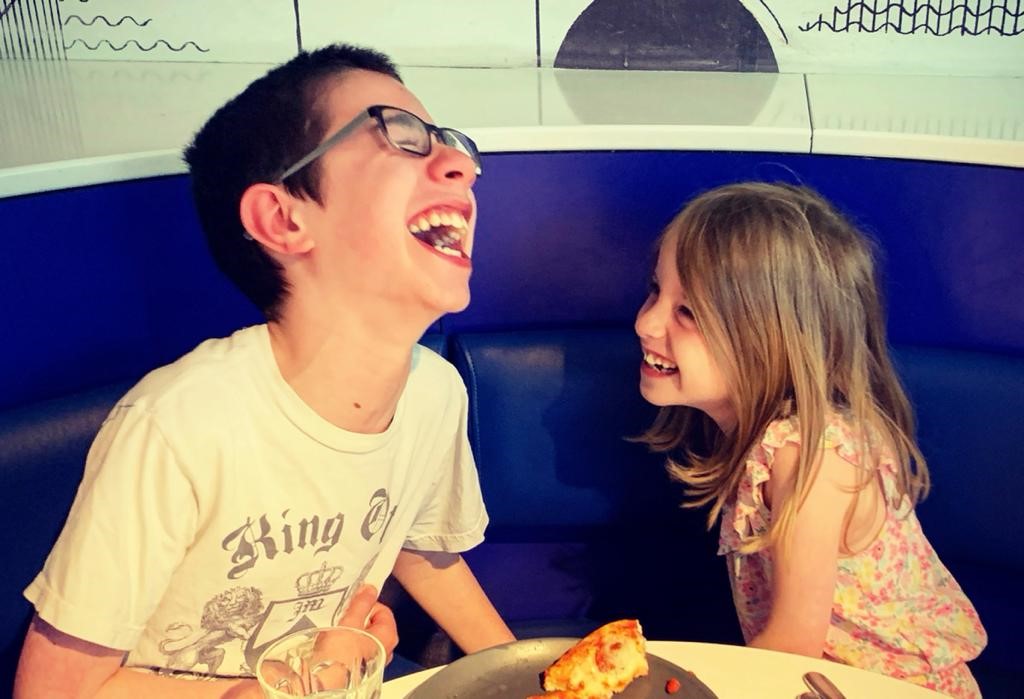
Chalk and cheese children are as typical as the centuries old idiom is truism. And of course, having dissimilar siblings many say is desirable.
Brother and sister not sitting side by side personality wise doesn’t mean they rough and tumble like opposite stands of a feverish football stadium. I’m broadly grateful for the diversity Isaac and Tabitha bring to family life. And candid too about the challenges and rewards. Treating my children according to their traits can call for kid glove handling; but their mutual grasping of their wildly contrasting strengths and needs, stops things going nuclear. Most of the time anyway.
Family life can, at times, be conducted more calmly when split into pairs, rather than always pootling along as a foursome. That’s undoubtedly universal though.
However, whilst not megaphoning it, I’ll more than whisper that Isaac’s autism has a role to play in our family behaviours, dynamics and discussions – not a major one but not a minor one either. It’s not an awkward conversation to attempt around the family table (when Isaac’s decibel sensitivity or dietary requirements allow it.)
Simple observation informs some specific needs to personalise parenting either way. The nearly nine-year old Tabitha is safely embarking on her embarrassed-by-dad journey; seeing the stabilisers coming off as she scarpers into school, eschewing goodbye hugs, or banishing me from the bedroom when friends come to play isn’t too devastating. Despite all the little buddies’ whispers and shhs and giggles, it’s a smooth ride we both take in our stride.
Thoughtfully, tempers and tears she keeps for us, with Eliza (my wife) tending to any real troubles big and small, with her deft, telepathic hand. Mental health is monitored, channels are open 24/7, all avenues accessible including discreet dialogue with brilliant teachers when called for.
Whereas if Tabitha’s embarrassed and self-conscious behaviour echoes all empirical evidence (psychotherapist Fran Walfish is one of many to have studied and confirmed that between 7 and 9 it all kicks off and my own memory certainly concurs), Isaac’s take is altogether more complex in expression.
Whilst Tabitha hones the tone of voice tricks in public (adapting to teachers and many adults for that matter) by being simultaneously down with us and an utter doll with others, this sociability survival mechanism remains elusive for Isaac.
Two distinct voices fit the majority of his moods, both raw and direct reflections of his extreme experiencing of the world around him. Many highs, many lows, few in-betweens. Regulation may be a rare commodity as he overinvests himself in the perilous stages of puberty and growing up.
His school is the life-saving sponge for this, Isaac himself acknowledging when some episode needs instant attention:
“I’m autistic, my school will never behave in a mainstream manner. Which I must admit it does not. Though I have a problem that, please dad, you need to speak today face to face with my teacher about! Do not message by email or text. I’m anxious, it’s hard, now dad.”
Tense and to-the-point, imploring communication between me and the teacher. Qualms about who hears or is told are non-existent as the quivering Isaac unleashes his problems irrespective of place or person; often at the school gates after a hard day or particularly agitated early morning when he feels “not well with anxiety”.
Our hotline to school, used when appropriate but not – gratefully – as a last resort – allows us to channel Isaac’s interpretation of all school events, what he says, to whom – and vice-versa. His teacher (whose brilliance and empathy words can do no justice to) achieves the impossible regularly. Assuring him that getting older is ordinary, articulating that pressure can be positive, mediating between him and other students, firmly but reassuringly telling Isaac to limit involving himself in other social situations that don’t concern him. That’s just a snippet of his teacher’s Talmud of techniques that seem tailored for Isaac.
Whether re-evaluating learning breaks, when to use noise-cancelling earphones, dialling up therapy sessions, the ongoing work on Isaac is both enormous in scale and granular in detail; in fact any embarrassment or self-consciousness on Isaac’s part would hinder progress (cleaved in somewhere here are the finer details of puberty, Isaac immune to the oxygen of natural teen chatter and peer to peer learning, means logical explanation by experts of subjects is bumpy for me but assures inappropriate behaviour is more likely to be avoided). This is actually invaluable in my pondering of Tabitha’s future, knowing what she may hide or try to solve for herself could need close inspection. How instructive autism and school settings can be.
Talking of which, my shudder when contemplating the alternative educational settings Isaac could be in is getting ever more convulsive.
All this is not to say he doesn’t have embarrassment incidents that give me a where-did-that-come-from shock akin to a bird flying and flapping into an attic – and as stubborn to set free:
A sudden, “I am embarrassed of my dad, please go, it’s difficult with your face here,” can emerge emphatically at any time in a social situation with an elder teen cousin or uncle, spinning me into an epically sticky stick or twist scenario with my uncomfortable self. What to do.
Then from nowhere, he’ll yank me aside and loudly yell, “I’m having trouble reading emotions right now dad. I’m not being rude but I don’t feel I can talk any more to these very lovely people. I am anticipating that it’s time to play Train Sim 2; yes, the Bakerloo line scenario labelled “Taking Stock” where I must concentrate and prepare to leave the depot at Queen’s Park for service northbound. On my own. Or maybe I’ll try “Around Haul”, travelling around the entire line, obtaining points, operating the very real controls in the cab. I can’t be interrupted. Bye. You can message me.”
And off he goes.
How we deal with Isaac’s and Tabitha’s school experiences more generally has a simpler, more straightforward contrast. And one that they tolerate, on the surface tougher on Tabitha; but her typicality is undoubtedly to her benefit here.
I often find, scrunched up and out of sight at the bottom of Isaac’s bag, certificates praising his accomplishments in science or English, a behavioural achievement or show of maturity, a gold in maths. In exactly the same way that I secretly stowed away rotten school reports (so many Cs in my Victorian school’s ABC quarterlies), so he squirrels away his glowing school news. Instead choosing to focus on his day’s faults and difficulties, whether the pain of holding instruments in art, trying to please teachers, himself fuming at his frailties. So many in his head, as he misinterprets encouragement for impatience. The aforementioned joining-up with school appeases, but it’s labour intensive to say the least.
It means a divide between school’s daily heavy toll, and a lighter approach to homework is necessary. Keeping the worlds apart critical to his being.
Conversely, Tabitha can be cajoled into homework, with her sense of reward something I relish. She’ll proudly present a certificate she’s received for effort or endeavour, then dip before immersing into homework, with screen time or treats a simple carrot (metaphoric not literal of course).
Comprehension and co-existence then, with each fortunate to have their own space. Learning to love and appreciate each other’s quirks. With our parenting attempting to treat them with identical care and love while adjusting the flavour as to how they see and feel the world around them.
This edifice of equality of actions and feelings was tested to its core foundations though, when COVID came calling. Tabitha’s two day fever, miserable in nature but manageable to nurture, called for a fun family outing to Brent Cross Car Park for PCRs. Nose tickles all around.
My head went nowhere for 24 hours. Some subconsciously crafted compartmentalisation kept normality on track. But then in dropped the results. An already healing Tabitha positive, a yet to be stricken Eliza, positive too. Myself and Isaac, negative.
One of Isaac’s chief challenges is coping with change – and this never changes. Inundated with impossible to process thoughts of how the family would face the incoming turmoil, I couldn’t help but cling on to a gratitude that it was Isaac who was negative, primarily for his mental health; leaving the house for train trips, our daily close-quartered (in his room, around a screen) train simulator journeys together and his repetitious sensory needed squeezing of me were safe.
The physical effect of the illness itself had been rotten but had now started to subside with Tabitha, as it does with children in general. Illness is amplified with him, a sniffly nose plays sensory havoc, unpredictable pain thresholds make any sort of bugs a biggie for him. Yet the overriding relief with Isaac was that for now it was him who was negative and therefore free of the mental anguish to isolate.
But then the guilt of thinking all this – even with the whole spectre of lockdowns still casting a shadow over both of them, I found myself thinking the dice had rolled favourably. Evidence hastily but robustly accrued this last eighteen months backs up autistic people’s more troubled responses to the pandemic, especially lockdowns in all their forms, as well as their litanies, namely social distancing and mask wearing. This knowledge softened the sharp edges of guilt that had started to stab away at me within seconds of the results coming in.
Whether Ambitious about Autism’s detailed reports about negative impacts on mental health, wellbeing and learning (with brilliant resources and policy suggestions a complement) or Asbury et al (2021) studies of parents of children with special educational needs experiencing anxiety and low mood, there’s a broad consensus: autistic people probably feel the effects of covid with more intensity.
Needing to get a grip, Eliza still just about at the family wheel but now fading, guilt got out and took a back seat. Practical responses took precedent. Keeping apart and getting my pitiful culinary repertoire perfected were the prime aims.
The last vestiges of Eliza’s wellness were her instinct and intuition, thank the Lord. It began with a ringfencing of the bedroom ravaged with potential infection where she and Tabitha could be together. Snuggling for Tabitha plus the delivery of Eliza’s ingenious gift of an early advent calendar, mollifying the countdown to freedom with daily gifts. The strategy for the younger sibling possessed a straightforwardness, seemingly highlighting the contrast with her older brother.
For despite Isaac’s negative test, we felt it was necessary and correct to take him out of school there and then after some consultation. Systems would be put in place, but routine was to be ripped up and left in tatters. A crumb of comfort was that we were on the cusp of half term. However with the covid result in, I had to pick him up from promptly, mid school day, where his teacher was confidently safeguarding an Isaac in touching distance of incandescence.
If Isaac’s everyday manner of delivering speech is exuberant news reporter – one way to a virtual camera, his world the main event, facts and honesty – then he’d quickly shifted into on-the-ground war correspondent:
“I’ve just had my maths lesson disrupted, with this covid situation at our house. Mum and Tabitha are positive Covid people at this point of time? Is this the situation dad? I will need some schedules. This is a disaster. Please consult with my teacher here!!”
Shaking, despairing, dodging the hand grenades of information blowing up in his head, I got him in the car. For the duration of the journey home, I let him have a turbulent conversation with himself. It was like a distorted analogue FM radio wobbling between two stations, one composed correspondent, one not.
“How can this be fair, this global pandemic now with mum and Tabitha, I’m am predicting this will be terrible for me dad. You have to do something.” Then, a pause, and a mild dampening. “Oh, they need to be loved. I do love them so much. I must help. But how. I can’t be in the house. Dad, dad??”
He put it all out there, and anything I proposed was frankly pathetic.
“It will be hard Isaac. We’ll cope. You may have to grow up a little.”
“What? How can I grow up?? I am this height. I cannot just be bigger. This is my body now! Why are you saying these things?”
Gesticulating to himself, lecturing me with his specific literalness. His autism justifying this response. A little example of why now was the worst time for me to not speak his language.
“My school and education!! It’s important I understand. But this remote learning. Doing it again. Oh my, this will be a terrible thing for my mental health.”
And then a third voice. The oft on, ever present, running commentary of train information. A mountain range of knowledge. The broadcast of which is a side effect of anxiety for sure; but that’s paradoxically a panacea too. It went into overdrive as we pulled up at the house, breathlessly bombarding me:
“Let me inform you of the core routes I can play on my train simulator game. It’s so realistic and real drivers use them to train. We must schedule times to play, just you and me dad, during this pandemic. Away from the positive Eliza and Tabitha.”
“And I must say, well done Rivet games, I’m proud of you for creating this amazing game. The Isle of Wight line, Brighton mainline, the Boston Sprinter, West Somerset Railway, South Eastern High Speed, Tees Valley line – that’s six as examples. Now for controls that I can use in all scenarios, there’s the dead man’s handle only on Bakerloo, but the master key to turn the power on exists on others. Carrying on, the reverser power slash brake controls are important. Safety measures like the Automatic Warning Systems, allow for isolation and make a beep sound in distress. But of course there’s a different safety system on German routes called S I F A.”
I sit and let him conclude, cognisant that what he was saying must be critical for him. Then a rapid gear change, “awful news from Sadiq Khan: the Bakerloo Line could be declining and not working soon!! This is tragic.”
What was clear was this transport pockmarking of his talk was his strategy for dealing with COVID induced change. It really was his real time resetting of his racing mind. So much so that once in the house, with Eliza now bedridden and beginning a 2-3 week horrible hibernation, he assumed a role within the house that allowed him to acclimatise in his autism-flavoured way, and Tabitha in hers.
With the single-minded focus being on our survival and Eliza’s recovery, Tabitha needed TV time, little gifts, care and attention, facetiming with friends; these enabled the attempted distance keeping from me.
For Isaac, I became his life size stress ball for him to squeeze and get the sensory input from, exacerbated at this time, and denied him by Eliza’s isolation. Compensatory cuddles were initiated by him, including the “five kisses on my head please, dad, and now another two”, regularly administered throughout the day. Which have carried on to this day.
We were able to go trainspotting – life saving, perhaps. Overall though, my guilt slid away, as if Isaac had been positive, as he may be one way, I now knew he would have found a way through.
What really taught me though, was that at a time I believed I’d need the logistics skills of an owner of a fleet of lorries with insurmountable supply chain issues, Eliza’s health was singular and everything (hospital a whisker away, but fortunately avoided) – which meant feeding the family and keeping calm.
And in this extraordinary situation, my chalk and cheese children chose their paths accordingly and succeeded. They’re six years apart but close in life knowledge perhaps. What she knows in nuance, he makes up for in his lake of love for people, flooding them so often with passion and politeness. Her imagination flourishes gorgeously, his brain never ceases to amaze; like knowing exactly when to run for a train or walk when approaching our local station, because the specific sounds it makes at specific points as it pulls into the station, flick a timed switch in his head that GPS like give him precise coordinates and speeds.
In this time of mild distress, Isaac and Tabitha carried on, were themselves, filled the house with love and strength. My fumbling around, keeping a hand on their difference, aware autism is the fifth member of the family, adding weight and balance, faded a little. We all reacted accordingly, and if anything, whilst they might have been trying to stay physically apart, the experience of COVID distributed differently under one roof, sealed their closeness as brother and sister, and Jane Austen’s quote about siblings was brought to mind:
“Children of the same family, with the same first associations, have some means of enjoyment in their power, which no subsequent connections can supply.”
Isaac and Tabitha will always have each other. They are wonderfully different but add a magic to each other’s worlds. And when Eliza was better, those worlds were made pretty perfect again.
(I always try to respond)

12 Responses
Just wow Matt!! What a stunning and beautifully written piece. As a neurotypical older sibling of an autistic person myself, the way you write about Isaac and Tabitha’s relationship resonates profoundly with me. Your level of insight and understanding clearly does the world of good for their sibling relationship and your family as a unit.
Parents like you and Eliza (and I’m fortunate to say my own mum and dad) are pricelessly important to young autistic people like Isaac and my brother Adam! So sensitive of the differences, and yet so aware of the incredible power of the shared experiences which bind us together as bothers and sisters.
Another fantastic read, I look forward to the next one!
All the best and take care,
Joss
This is a beautiful comment to read, Joss. You are perfectly placed to observe and feel the sibling experience. So hearing that it resonates, means so much. Thanks so much. Matt
What an amazing piece, Matty. Incredible. The are both awesome kids xx
Bless you x
As ever Matty an amazing blog. Love how you have compared Isaac and Tabitha’s personalities!
So proud of you and Eliza.
Thanks so much x
This was such an enjoyable read, again. Thank you . Rich
Thanks Rich, much appreciated. Matt
As insightful as ever Matt. I learn so much when I read your blogs. Thank you for giving us a window into your family’s world. I hope Eliza has completely recovered.
Thank you, that’s such a wonderful message. Love hearing things like this. And all recovered thanks!
Wow Matty…’enormous in scale and granular in detail’. Says it all. Stunning account of Covid times in the Davis household. Brilliant as always. Xx
So kind, so appreciated. Thanks loads xx