
Now that I no longer lie wide awake with worry about Isaac and his autism, I feel able to dabble in the thinnest of dreams. A notch-above-zero tolerance to wondering what may be.
There’s a ton of bricks caveat that dashed hopes or, worse, dead ends await. It will never be possible to stop being scared stupid about ignorant prejudice around autism pummelling Isaac’s ambition and ability. Most forms of explicit positive pondering do, in the most part, get kicked down the long road to nowhere.
But that doesn’t mean I can’t dust down the 11 year old, pre-birth, crystal bowl. Indeed I wrote at the beginning of this year that now that autism had belatedly got its tentacles into the nation’s narrative around diversity, I can have a sniff of what the future may hold for Isaac – extinguish some fears, spark some optimism. Still, even as recently as then, the whole autism hinterland seemed an unknown, invisible place. Too many extraneous influences more than anything. Why shed too much light when there’s very little to be shed.
Not that I imagine most parents of typical kids dream big anyway. It just must seem a simple and tempting side effect of conventional learning – from natural milestones reached, through to specific environments that elicit specific thriving and outcomes, to the dreary but dreaded SATS, coursework, and beyond.
Perhaps when achievements are less ambiguous and more sequential than Isaac’s, it’s easier to internally transform your child’s every act into a seductive plot of drama and success and opportunity. (Believe me I’ve been (am) there. Have I told you about my daughter’s arts and crafts skills? I’m not saying she’s a shoe-in for art school, architectural brilliance, product design…but one never knows!)
So with the drawbridge creaking open for dreams, Isaac’s future from a tangible perspective is firming up in my mind by the day. Reality, challenge and the need for reassurance in the main. Importantly though, I’m looking forward and things are looking up.
The reasons are many and varied. To start with, in what seems like just 12 months, autism has earnt its place in the country’s ecosystem. Whether as an NHS priority or further exposure in the workplace, the handbrake’s off on autism awareness. But the negativity and lack of knowledge seem neck and neck with the good stuff.
Because whilst just from a term perspective, autism might have hopped high in Google’s rankings, it doesn’t stop – or increase – situations like primetime TV’s Richard Madeley, recently comment in front of an autistic young man:
“The thing with Daniel is, he has autism but is very intelligent…” before asking his mother (not him!), “has he always been autistic?”
What a bizarre and blunt thing to say; Madeley sounds like the unfunniest comedian (which maybe he is) not even trying to tell a joke but still falling flat – on his face.
All this chatter then, the good and that bad, gets naturally distilled into my mind. And despite that caveat, those comments, the glass is tilting half full towards my inner dreams. Plus, I have Isaac himself on real time, getting older, now 11, his place in a world bigger that will maybe become more acceptable.
Novelist, Martin Amis, talks of an assumption that “our particular (personal) is universal.” At this point in Isaac’s life story, I may be doing just that.
This present day son of mine, whose magic infuses any room he enters like fresh roses, could continue to enchant in an ever more accepting (part of) society.
To the universal organisations, British Airways (BA) and Eurostar, let me say Mazel Tov, with their very recent facilitation of our transition through the disorder and disorientation of travel.
For example, the BA staff were only to keen to help an adaptively communicate with Isaac, his language and enthusiasm sounding like a welcoming 1950s shopkeeper. (If not repetitive and a bit narcissistic):
“I’m autistic, I’m very happy to not queue, I really don’t mind, please don’t worry, it’s OK. We’d like to go where the transit is departing, to then alight. Now let me get this straight, the transit is departing from gate 43.”
The subsequent transit experience gave him the coping tool throughout the holiday to repeat (and repeat), with his usual astonishing accuracy, “Please stand clear of the doors, transit is departing.” Bit annoying let’s admit, but satisfying for him of course.
And TFL, take a bow. Isaac’s possesses a “tunnel” vision around trains and being a train driver. So when he was officially allowed to ride in the cab for the entire Northern Line (both ways), nirvana was comfortably reached:
On arrival at the platform, my heart skipped a beat as he went to kick the driver’s door – but that’s where the button to open it is, “silly dad, awful dad,” who knew? Well, the smiling driver who took us did, that’s for sure.
Said driver should have been exhausted by Isaac’s questions and commentary but no; his energy as ever helped:
“I love this place, I love all the announcements, and it’s absolutely mind-blowing right now.”
And surely, all passengers must have cracked a smile, when they heard Isaac deliver the announcements instead of the usual recorded ones, including a keen, “remember those golden rules to stand behind the yellow line.”
He even pressed the buttons to open the doors – effectively driving a semi-automatic train – and “did the whistle, I did the whistle!”
What a day. There was certainly some dabbling in dreams, for him and me. Autism alive and well in the ecosystem enabled them definitely.
However, I am only too aware that, to go back to the Amis quote despite my experiences with these brilliantly autism aware organisations, it’s an assumption that my and Isaac’s life is universal. Far from it.
Especially at his extraordinary school – which is incredibly rare when you hear of so many people’s educational journeys – children’s and adults’. I pray others get the same magic, and touch wood that his school never changes (both strange behaviours for a Jew but these are unusual circumstances).
His life skills, from making his own toast and creating sandwiches, to trying new food, come from the diligent, inspired teaching that includes specialisms like occupational therapy:
“Tuck in everybody,” he’ll say, pride of place at the head of the table, when we couldn’t even have dinner together before (this doesn’t happen every day I should stress, but what a success.)
There are regular phone calls home from school from a delighted Isaac:
“Hi mum, this is Isaac Davis, your son. I tried lettuce today, are you proud?
I can’t imagine I will eat it again, but I tried something new.”
There’s a fluid, non-linear, innovative and interventionist approach to learning at Isaac’s school. Plus the work on his social development, slow and deliberate but intense. Whether age appropriate or not, his learning plan focuses and flourishes – independently identifying shapes and vertices, fine motor skills worked on to create dot to dots, him dictating sounds and names in science, speech and language therapy rewarding him for conversations. An interest in human blood, capital cities and flags learnt (lots more than me).
That would be just one day’s information relayed by his teacher.
The holistic approach reaches every part of his being; when Isaac says on Sunday, “I’m not going to be sad about school tomorrow. But in this moment I have misery. It’s the Sunday feeling. I will manage it. Can I see you at 651 in the morning to talk about my lunchbox,” the articulation of feelings emanates from the work the school and (massively) my wife collectively do for him.
He may forever be heavy on detail, gripped by his routine, logical and literate – and light on inference, precis and spontaneity. Which will be a lifelong balancing act; however it’s what makes him, him in so many ways. Who can’t enjoy his desire to “talk about dates,” that demonstrate his miraculous memory, or invite me to, “now discuss some memories from my childhood, like we did yesterday.”
So the present and personal has never been so prosperous for Isaac. Even considering the rapid shifts of mood, always seconds from sensory overload and misunderstandings, there’s enough of a catalyst for starting to imagine.
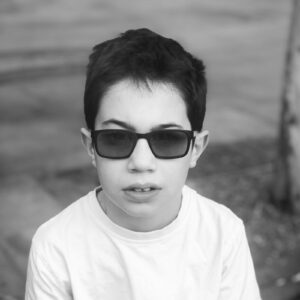 However, as touched on, when watching the wider world, what may not affect him now, but will in the future, and the dreams get clipped with the sharpest of blades. A sideways glance at Autism’s current role society, and the stats are scandalous.
Well over half of children with autism are not in the kind of school their parents believe would best support them. From a child’s direct perspective, we emerge in heart-breaking territory: 34% of autistic children say that the worst thing about being at school is being picked on; 17% have been suspended from school.
And in adulthood, the neglect and need for change is something the typical world just has to do something about, collaborate on, take responsibility for. The majority of autistic adults say that they are not getting the help they need from social services.
Then there is that one crusher of dreams: only 16% of autistic adults in the UK are in full-time paid employment. Scandalous from a human rights perspective and considering what talent is being lost.
At which point, I can’t help but join the demand for the dreams of so many to swing towards action. However wildly determined that needs to be.
There are visionary and life-transforming organisations helping get people into employment, but they are fragmented and disconnected. By their own admission, some of these organisations would benefit from support, coordination a more commercial approach. So many concur that a recruitment business would help persuade employers – from all industries – that there is a commercial and wellbeing case for recruiting autistic employees of all abilities. Beyond charity, beyond duty of care.
It’s a gigantic space that needs filling; I, with much needed help from a team of experts, aspire to help fill just small part of it. It’s in the idea stage but generating interest: to create a business, not a charity, that improves employment opportunities for autistic people. A dream that I’ve started to more than dabble in, and will try to turn into a reality.
.
12 Responses
I love you for all your hope and ambition. Our rock xxx
As ever Matty a brilliant piece of writing. It is full of hope and so humorous in parts. Proud mother!
Xxx
Inspiring and positive as ever. So good to read of Isaac’s development in your
unique words. Most impressive. Dad xxx
Inspiring and encouraging as ever. So good to see Isaac’s continuing development expressed in your unique words. Proud of you my son! Dad xxx
Matt
Stay on course, it will be a long journey but there is hope. My son is about 12 years ahead and he works 5 days a week in a caring, accepting environment. The team appreciates his skills as well as his humanity, humour and empathy. The statistics for working autistic adults in Australia are not different but change is coming and each one of us who understand and value ASD need to advocate for our children as well as others on the spectrum.
Hi
This is such a wonderful comment.. thank you. Hearing how your son is thriving is heartening. I’d love to hear more about the caring, accepting environment. Matt
Happy to share with you. Perhaps I can post some articles to you via your email matt.davis@redbrickroad.com?
Yes that would be great, thanks!
A particularly inspiring piece, thanks Matty. Your writing shows the passion you have to help improve the statistics, and your love for Isaac
Simon x
Such a lovely written article, really inspiring and encouraging from a parent in a similar but very different position. Take care.
Hi Nick
Thanks very much for your comment… glad you can relate – understand how different experiences can be!
Matt
Through adversary we can find inner strength and a better understanding. My heart is with you.